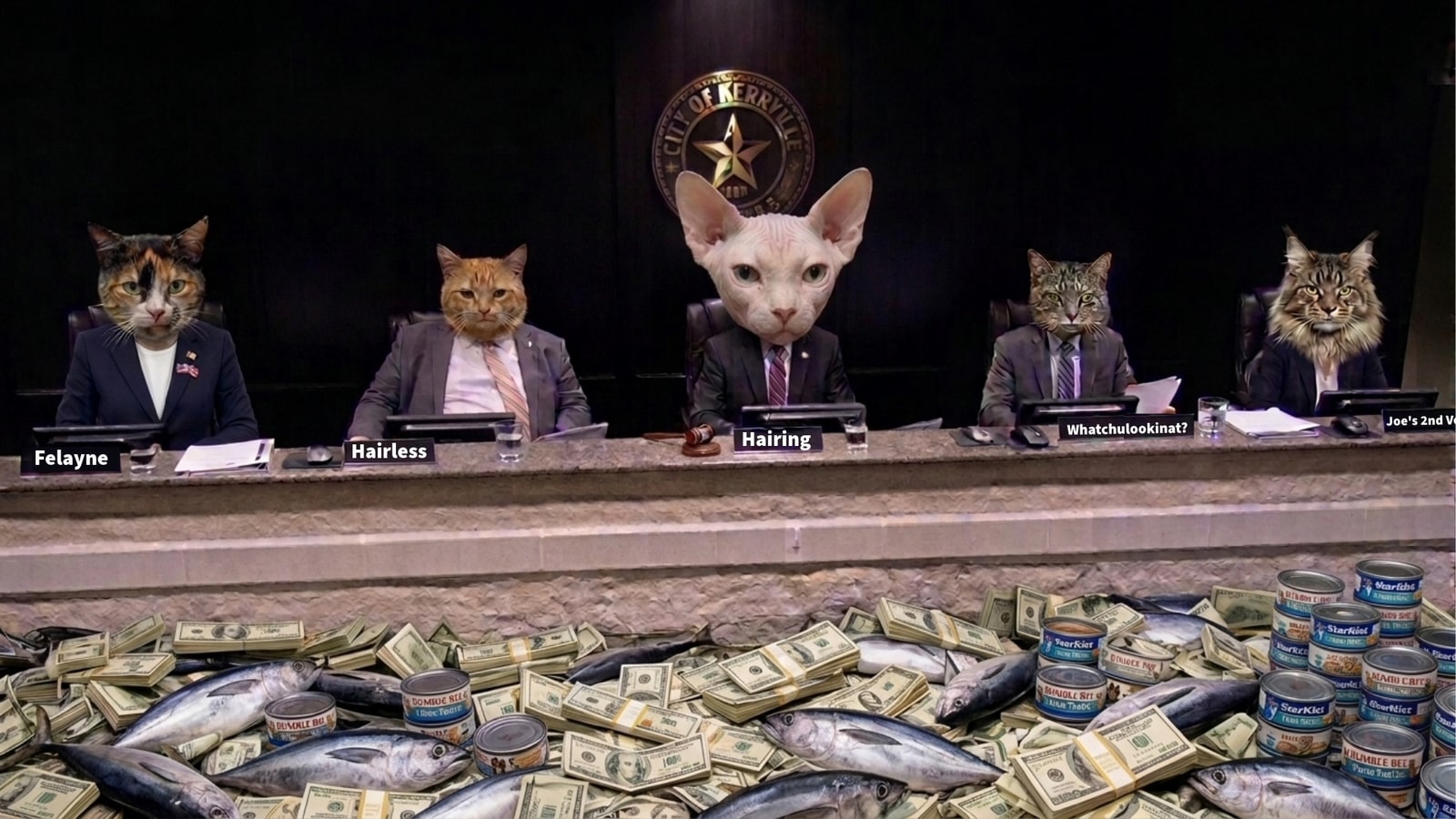
Council Bawks at Animal Ordinance, Harris Appears Clueless About Cat Research Lab
Two weeks after unanimously approving an animal code rewrite, Kerrville City Council tabled it. Staff said the ordinance hadn't changed; the mayor said council altered it from the dais. A council member who seconded it questioned its feeding ban, then asked where a research concern came from. County court orders answer that.
City of Kerrville
KERRVILLE — Two weeks after voting 5-0 to approve a rewrite of the city's animal code, the Kerrville City Council voted Tuesday night to table it before second reading, and sent staff back to work it out with the animal welfare groups the ordinance was supposed to have been written with in the first place.
Along the way, council members gave residents accounts of what the council had done, what the ordinance does, and where public concerns came from that do not line up with the meeting record, the ordinance text, or Kerr County's own court orders.
Council set a deadline of no later than the end of the year for Ordinance No. 2026-23 to come back.
"No Changes" — Then "Altered From the Dais"
Director of Planning and Development Drew Paxton opened the item Sept. 22 by telling council he was there to answer questions for second reading, and that "there's been no changes to the ordinance" between readings.
About 23 minutes later, after five residents spoke, Mayor Joe Herring Jr. described it differently.
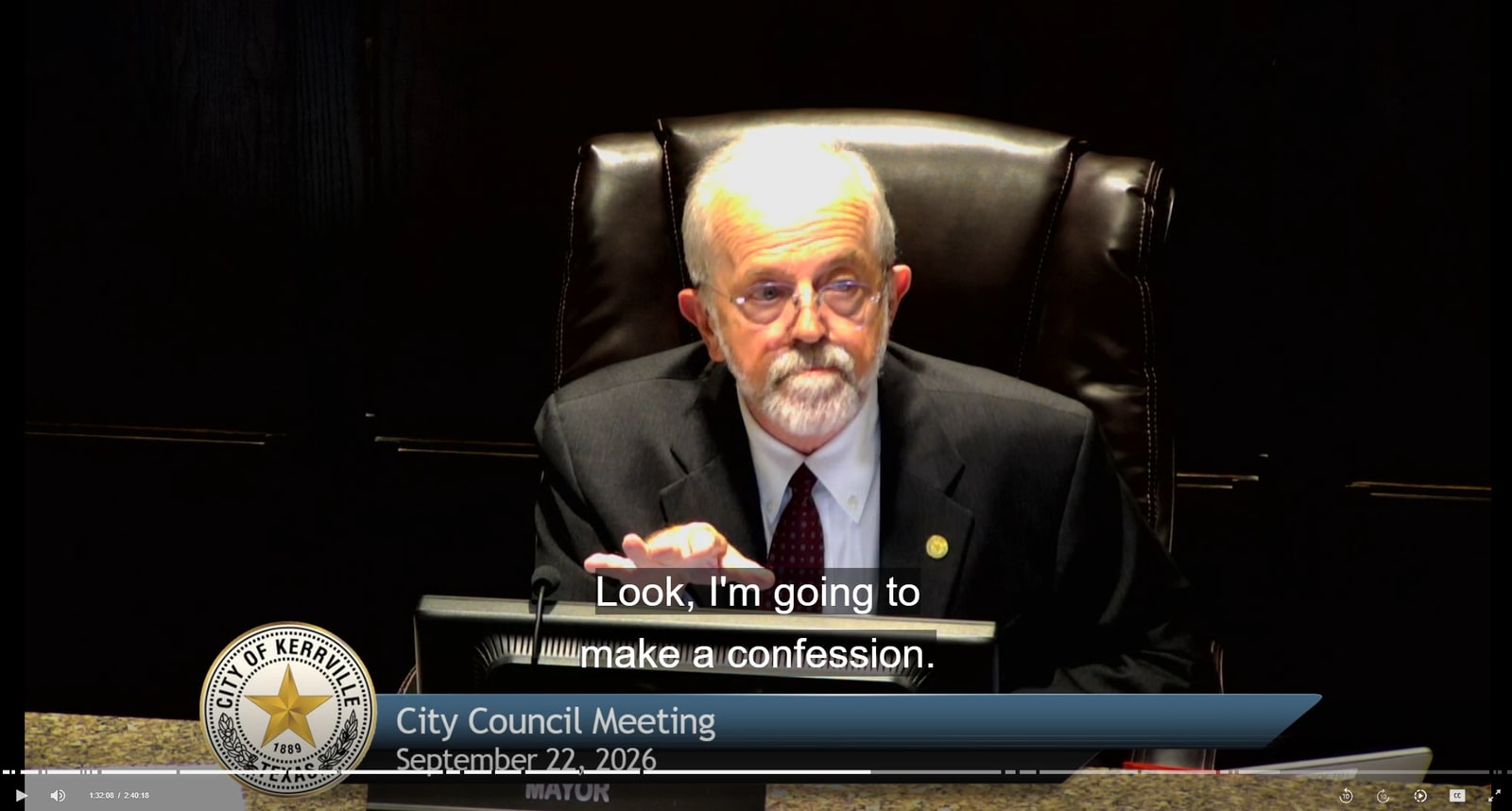
"What we have before us is an ordinance that has been approved on first reading, but was altered a bit from the dais by all of us last time," Herring said. "I think those alterations are what most people in the audience are concerned with."
He continued: "We had what sounded like a compromise agreement starting out, and then we made some changes up here during first reading. And now we have people who are upset with those changes."
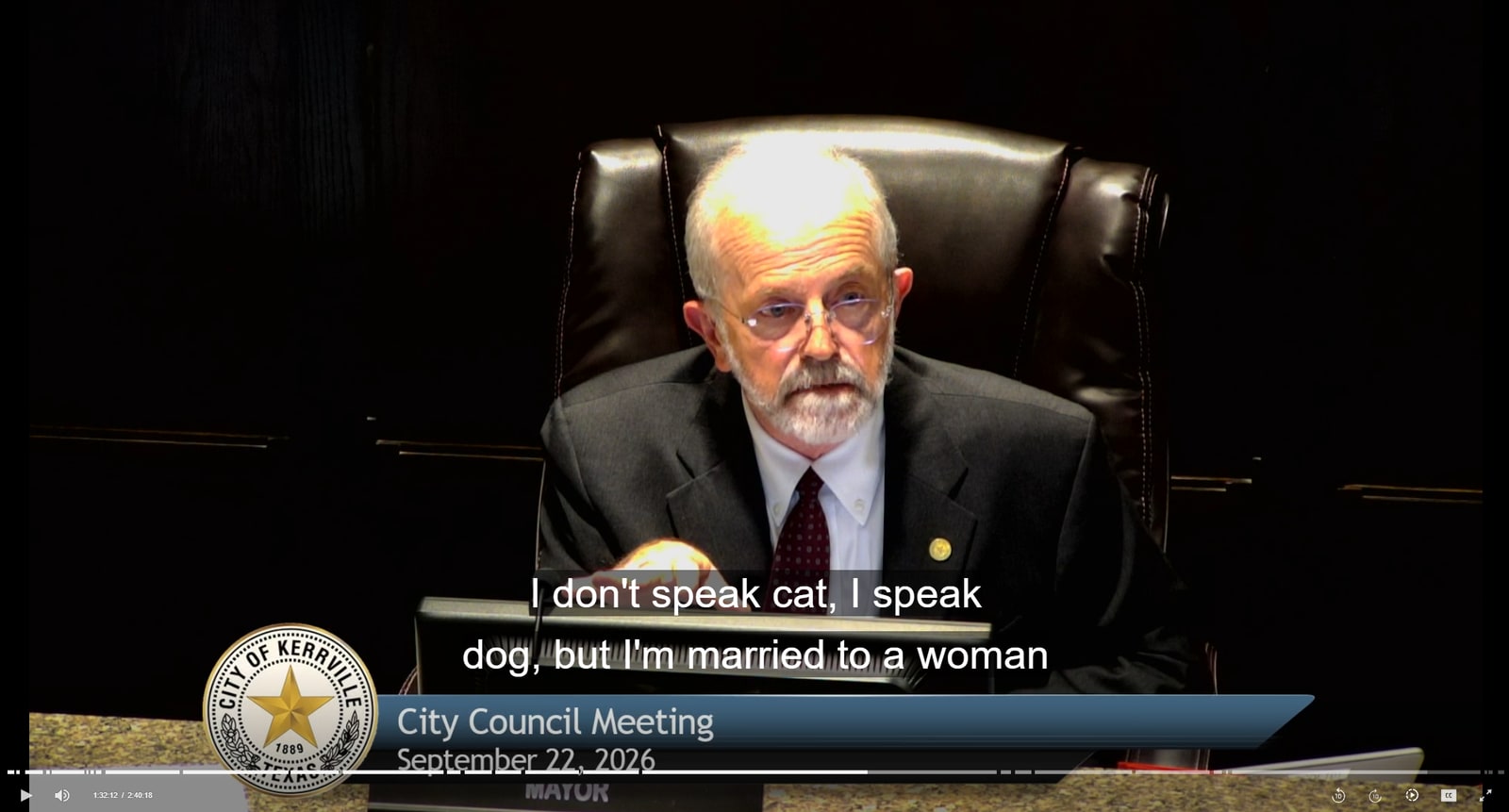
Paxton was right. The Sept. 8 video shows Councilmember Delayne Sigerman (Place 1) moving to approve Ordinance No. 2026-23 "on the first reading," with no amendments. Councilmember Jeff Harris (Place 2) seconded, and it passed unanimously. The Sept. 22 agenda packet carried the same Sept. 8 exhibit, and its cover memo lists no amendments.
The numbers people were upset about (the colony cap dropping from 15 cats to 12, and Councilmember Crystal Smith's suggestion of 10; the restaurant buffer growing from 25 yards to 100) were never in the ordinance. As KBN reported Monday, they live in a separate caregiver contract.
On Sept. 22, City Manager Dalton Rice told council that the draft contract, which Animal Control Officer James Lee wrote, was "just an example" that "has not even touched legal."
"So everything that's in the contract that we've talked about, those were just examples," Rice said. "And we did not do a very good job at clarifying that part."
Those "examples" were what council debated on Sept. 8, and what the city's animal welfare partners believed they had agreed to.
"When we left the September 8 workshop, Kerrville Pets Alive and the Big Fix felt like we had reached a reasonable compromise," Kerrville Pets Alive Executive Director Karen Guerrero told council. "At a subsequent council meeting that changed."
Asked by Herring why the ordinance came to council before the contract it depends on, Rice answered: "There is no rationale."
Under Sec. 18-34 of the ordinance, anyone who feeds or cares for a feral cat colony must register it and "execute a contract with the city." Registration is the only defense to the ordinance's feeding ban. Council passed the ordinance on first reading without that contract. Paxton said staff could finish the contract in October and bring it back in November; Rice said council would adopt it by resolution, which takes one vote instead of two readings.
"Just to Comply With State Law"
During the Sept. 22 discussion, Mayor Herring said it had been represented to council at the previous meeting that the ordinance "had been developed in coordination with several animal welfare groups, and it had their support," and that the changes were "just to comply with changes in state law."
Lee said he did the redline "to get it in line with the state ordinance."
The ordinance does more than that. Among its provisions:
- Feeding is unlawful. Sec. 18-31(e): "It is unlawful for a person to feed feral cats or to provide food for feral cats." Being a registered colony caregiver is only an affirmative defense.
- No intent required. Sec. 18-2(b) makes every offense in the chapter "nonculpable" unless a section says otherwise. The feeding ban does not.
- Three complaints and the defense is gone. Under Sec. 18-31(f), three nuisance complaints in 12 months from two or more addresses strip a colony of the caregiver defense.
- Mandatory euthanasia. Sec. 18-32(a): feral cats impounded on a nuisance complaint "shall be humanely euthanized after expiration of the redemption period" unless a caregiver claims and relocates them.
The staff summary given to council, submitted June 2, described the changes as "clarifying" definitions and "establishing additional requirements for management of feral cat colonies." It does not mention the feeding ban, strict liability, or mandatory euthanasia.
Harris: Seconded It, Then Questioned It
On Sept. 8, Harris seconded the motion approving the ordinance as written.
On Sept. 22, he read from it.
"Section 18-31(e) states it's unlawful to feed cats. How about deer?" Harris said. "Who in here feeds deer? Everybody. I'm guilty."
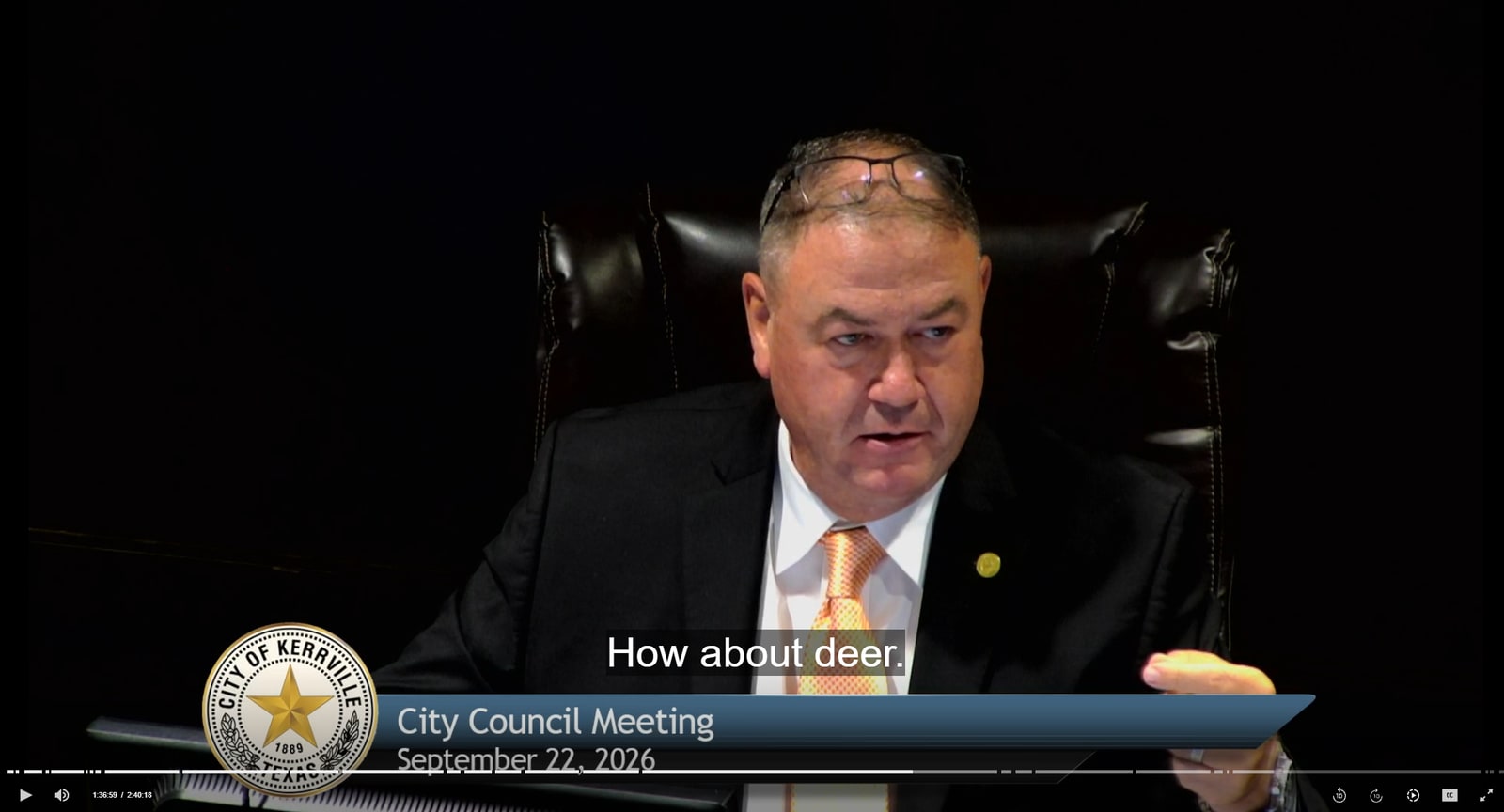
He went on: "I don't want to move forward with this the way it is right now. There's a lot of variables. There's a lot of moving parts."
Minutes earlier, Harris had addressed a concern raised in KBN's Monday preview: the ordinance says nothing about where euthanized cats end up.
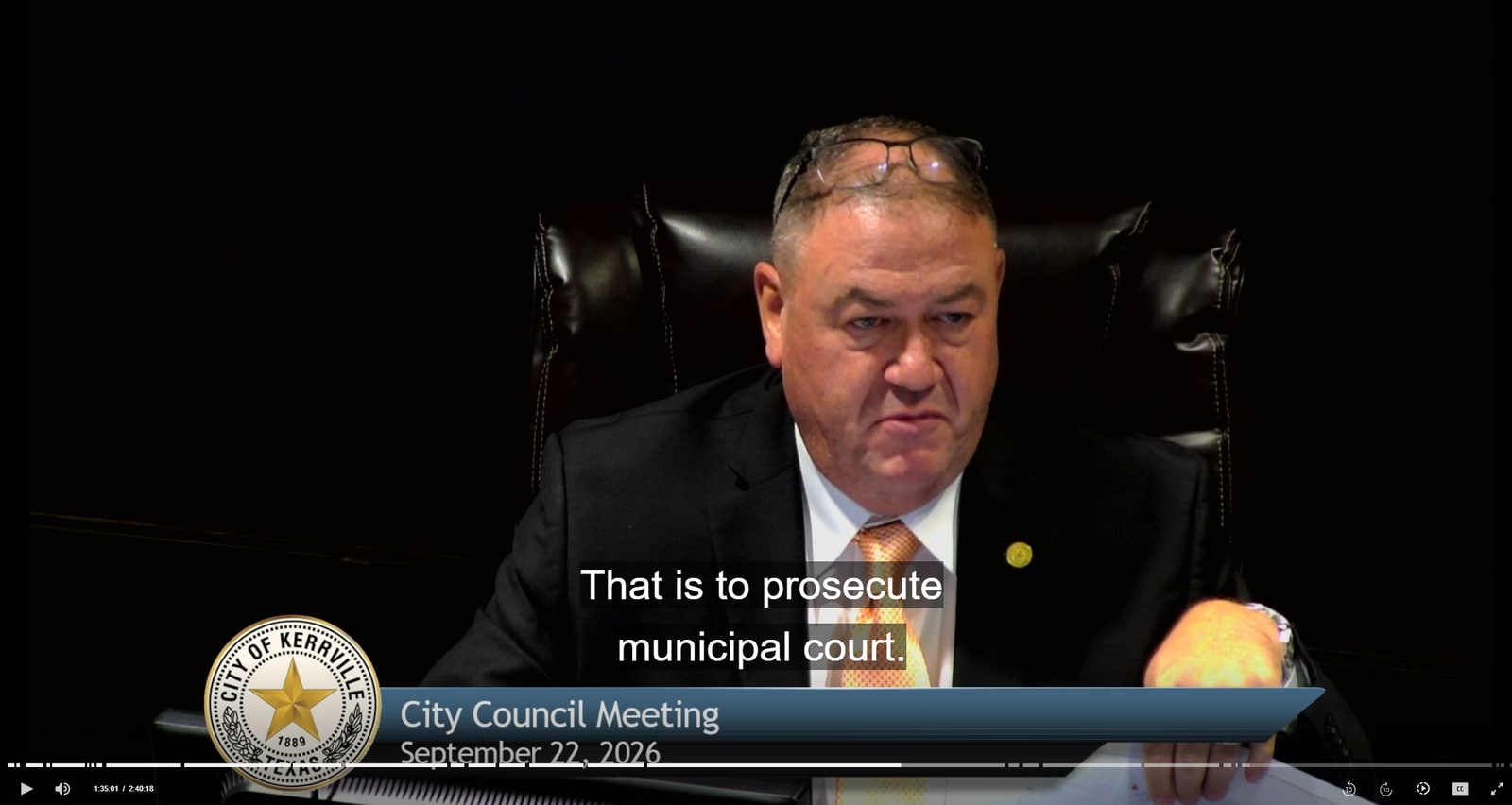
"I don't think that anybody on this council or with the city or Officer Lee or Chief Haley or anybody in here wants to sell our feral cats to research facilities," Harris said. "Where in the world did that come from?"
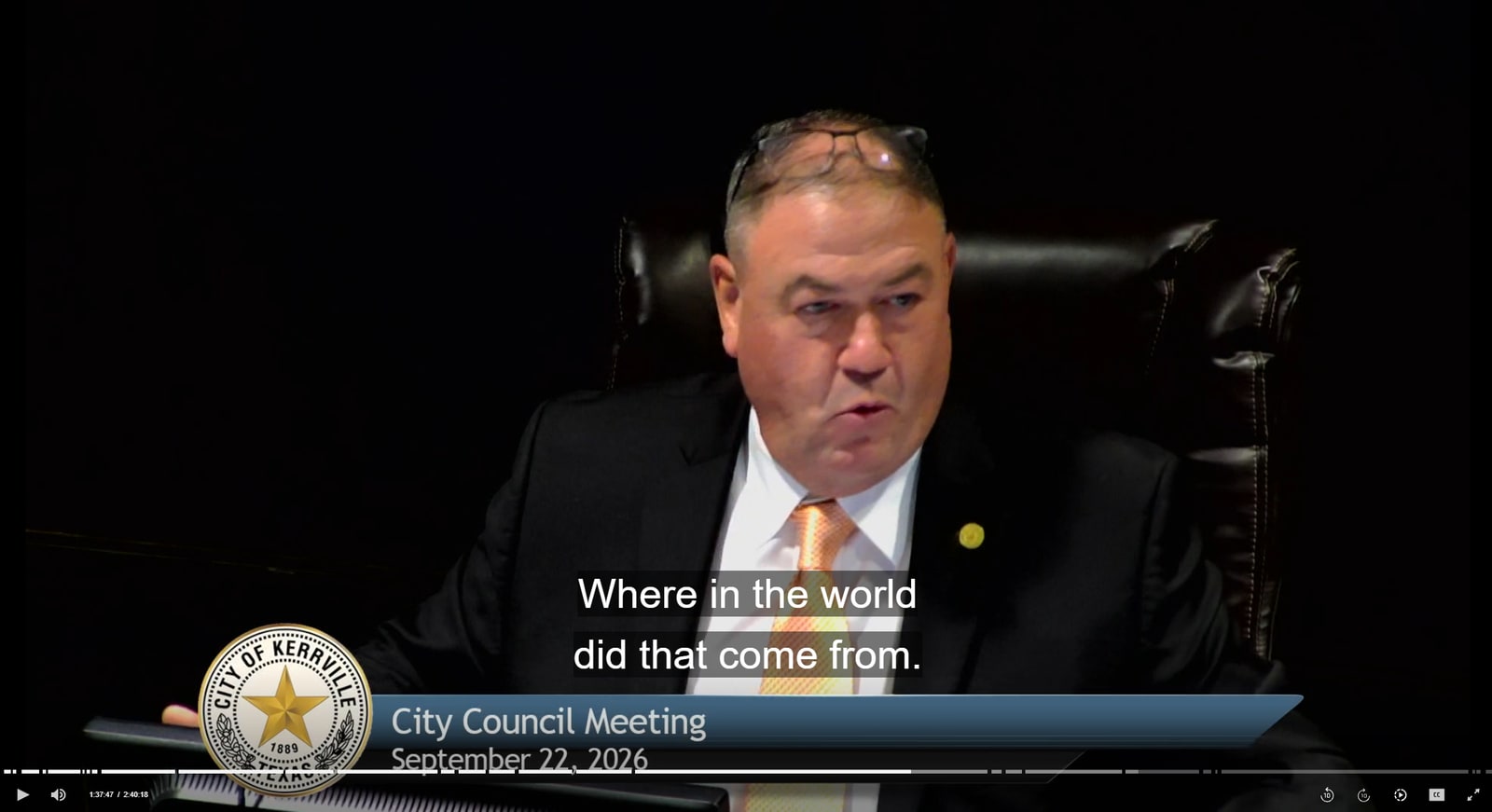
He said it was "not the intent of anybody that I know of" and asked residents to "help us dispel" the idea.
Where It Came From
It came from the Kerr County Commissioners' Court. KBN first reported on it in early 2018.
On July 23, 2007, commissioners' court agenda item 1.23 considered a proposal from Carolina Biological Supply Company to "purchase from Kerr County remains of euthanized animals for scientific, research, educational and/or other similar purposes." According to the county's 2018 court transcript, that became Court Order #30399, under which the county was paid $3.50 per euthanized cat.
On Sept. 10, 2018, the court voted 5-0 to rescind that order and authorized Kerr County Animal Services to donate euthanized cats to Rana Laboratories in Brownsville, described on the record as a division of Carolina Biological. Rana would pick them up at no cost.
Then-Commissioner Jonathan Letz explained why: "We've been accused of euthanizing cats so we can make $3.50, which was ridiculous from the start, so this eliminates that."
The county stopped taking money for the cats. It did not stop sending them. Since 2018, the arrangement on record has not been a sale, which is the one word Harris denied.
The city has no shelter of its own. Under an interlocal agreement in place since the mid-1990s, Kerr County handles animal control inside city limits, and the ordinance defines the "animal services facility" as one "operated by the city or county." A city feral cat euthanized under Sec. 18-32(a) would be euthanized at the county facility, under county practices.
KBN has not confirmed whether the county still releases euthanized animals to Rana Laboratories. No record reviewed by KBN shows the 2018 authorization being rescinded.
32 Chickens in "Chicken Lockup"
Harris also raised the ordinance's fowl section.
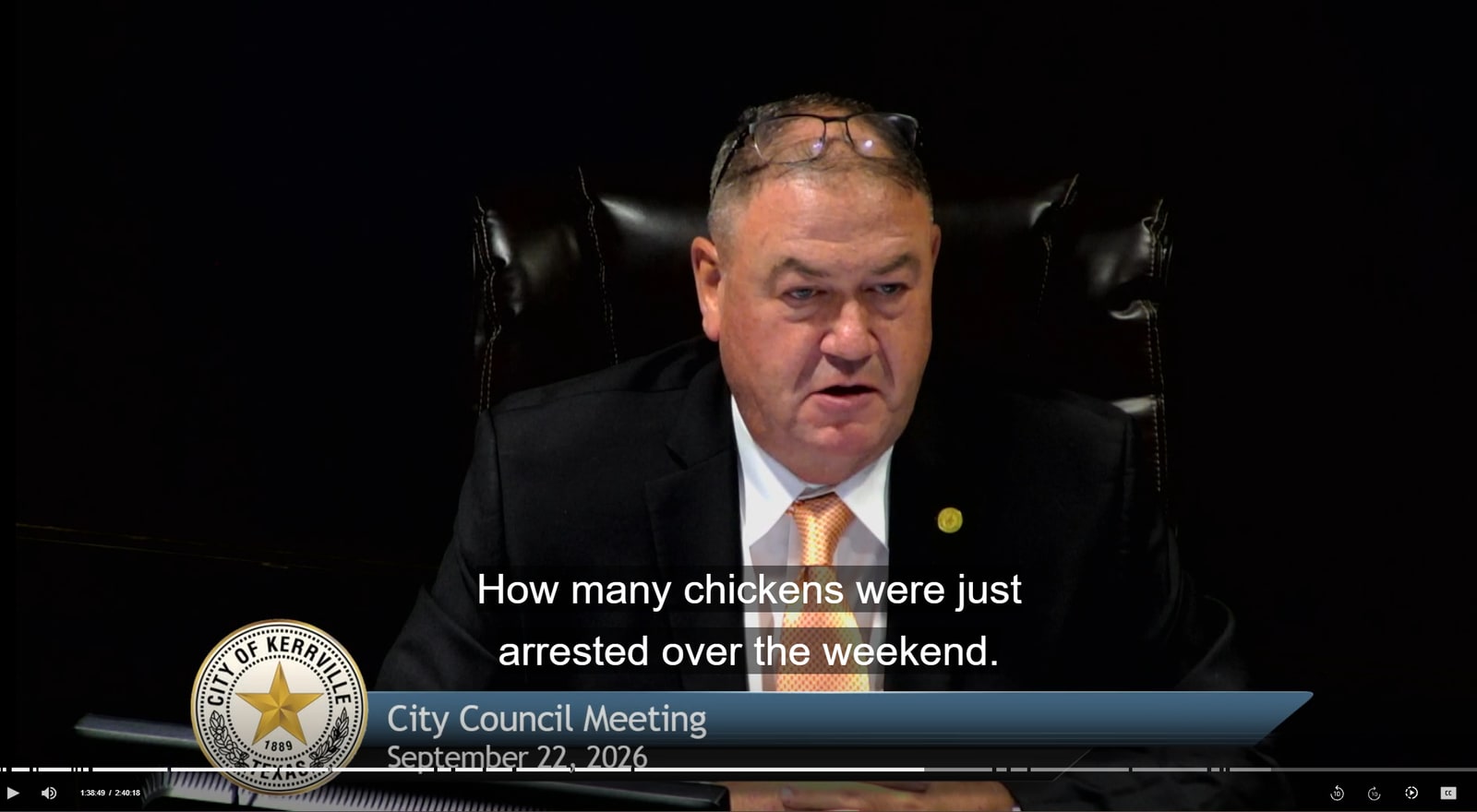
"How many chickens were just arrested over the weekend?" he asked. "32 chickens got put in the chicken lockup because in Kerrville, in the city limits, you can drive down Guadalupe Street in the morning, and there's free range chicken running around over there."
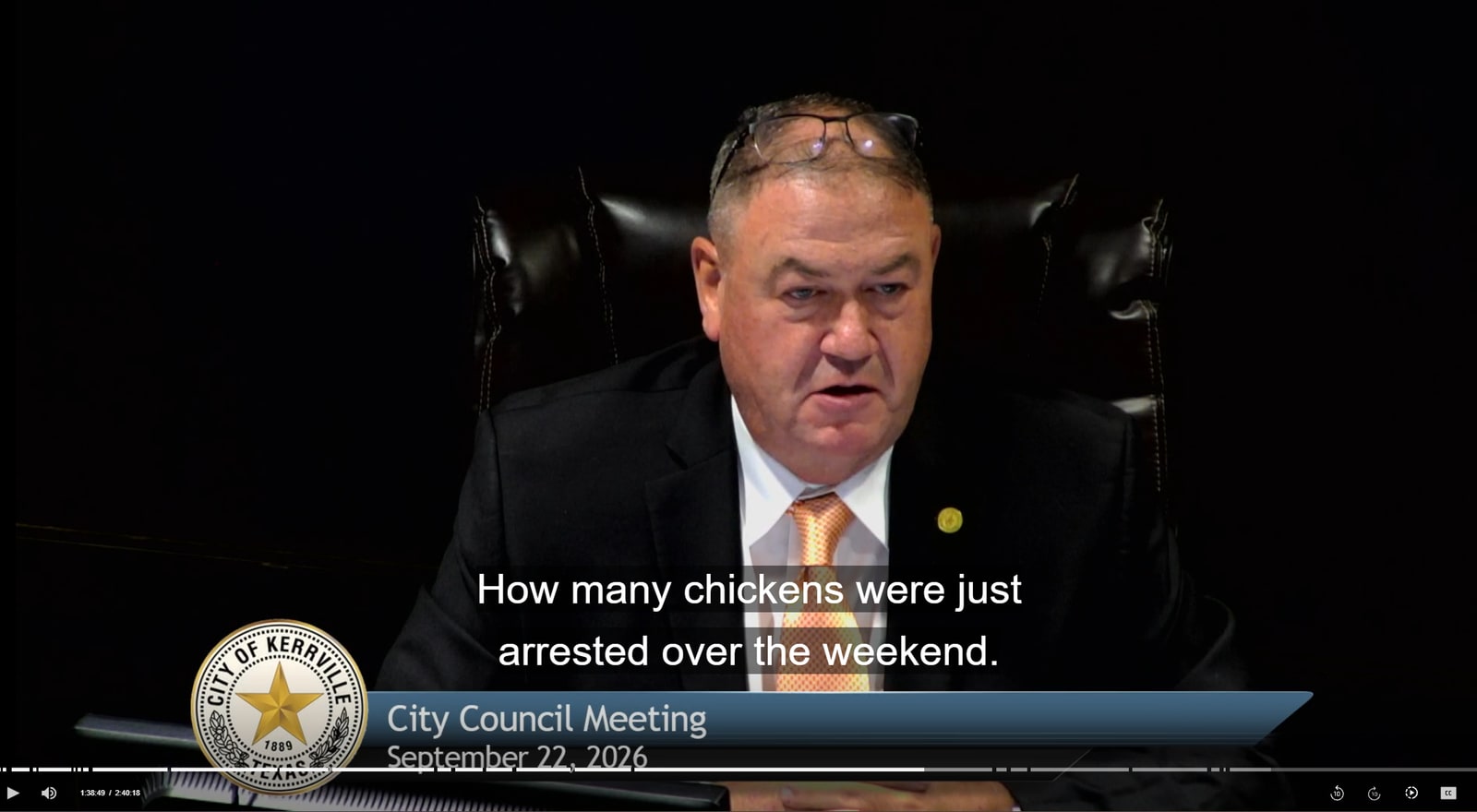
Enforcement under the city's existing animal code is already happening. Harris did not say where the 32 chickens were taken or what happened to them.
The Prosecutor Question
Charlotte Silvers, chair of the Animal Welfare Society, asked council about the city's appointment of San Antonio law firm Denton Navarro Rodriguez Bernal Santee & Zech, P.C. as special municipal court prosecutors.
"Do we, the city, have money to hire an outside firm? We have a city attorney," Silvers said. "How much is it going to cost? How is it going to be enforced? Who issues the citation?"
Harris answered that the appointment was approved on the consent agenda earlier that night, and that the firm is "not to go out and write tickets."
"Lawyers can't go out and write citations," he said. "That law firm is the one that's going to take care of traffic accidents, or not DWI, but public intoxication — anything that's arrested by the city of Kerrville is a class C misdemeanor."
The firm will not write tickets; Lee will. But violations of city ordinances, including the feeding ban, are prosecuted in Kerrville Municipal Court, which is exactly where the new firm will work. KBN's Facebook post ahead of the meeting, which Silvers appeared to be referencing, said people who feed feral cats "may just be hearing from" the special prosecutors. It did not say the firm would write tickets.
Harris did not answer the cost or funding questions. The answers that exist are in City Attorney William Tatsch's cover memo, detailed in Monday's preview: $230 an hour for associates and $250 for partners, compared with roughly $180 from two other firms. No estimate of total annual cost appears in the packet.
"Not in a Public Setting"
Herring said he never wants to "write an ordinance from the dais," and proposed the rework happen with staff and advocacy groups — "not in a public meeting, not in a public setting," before coming back to council.
Harris asked that the working group include the Big Fix, Freeman Fritts, the city attorney, Lee, the police chief and a council representative, followed by another workshop "because the last workshop was not very well attended."
Herring moved to table the ordinance before second reading. The motion was seconded and approved.
Herring told the audience to watch the city's website for the next workshop. "I don't know that we notify everyone," he said.
What Remains Unanswered
- Whether Kerr County Animal Services currently releases euthanized animals to Rana Laboratories, and how many have been transferred since 2018.
- What the special prosecutor appointment will cost in total, and which budget line pays for it.
- Who will be in the private working sessions, and whether their drafts will be public before the next reading.
Harris may respond on the record. KBN will publish his response in full.