"I Wish I Had That Much Hair" — Mayor Herring's Response to Frustrated Taxpayer
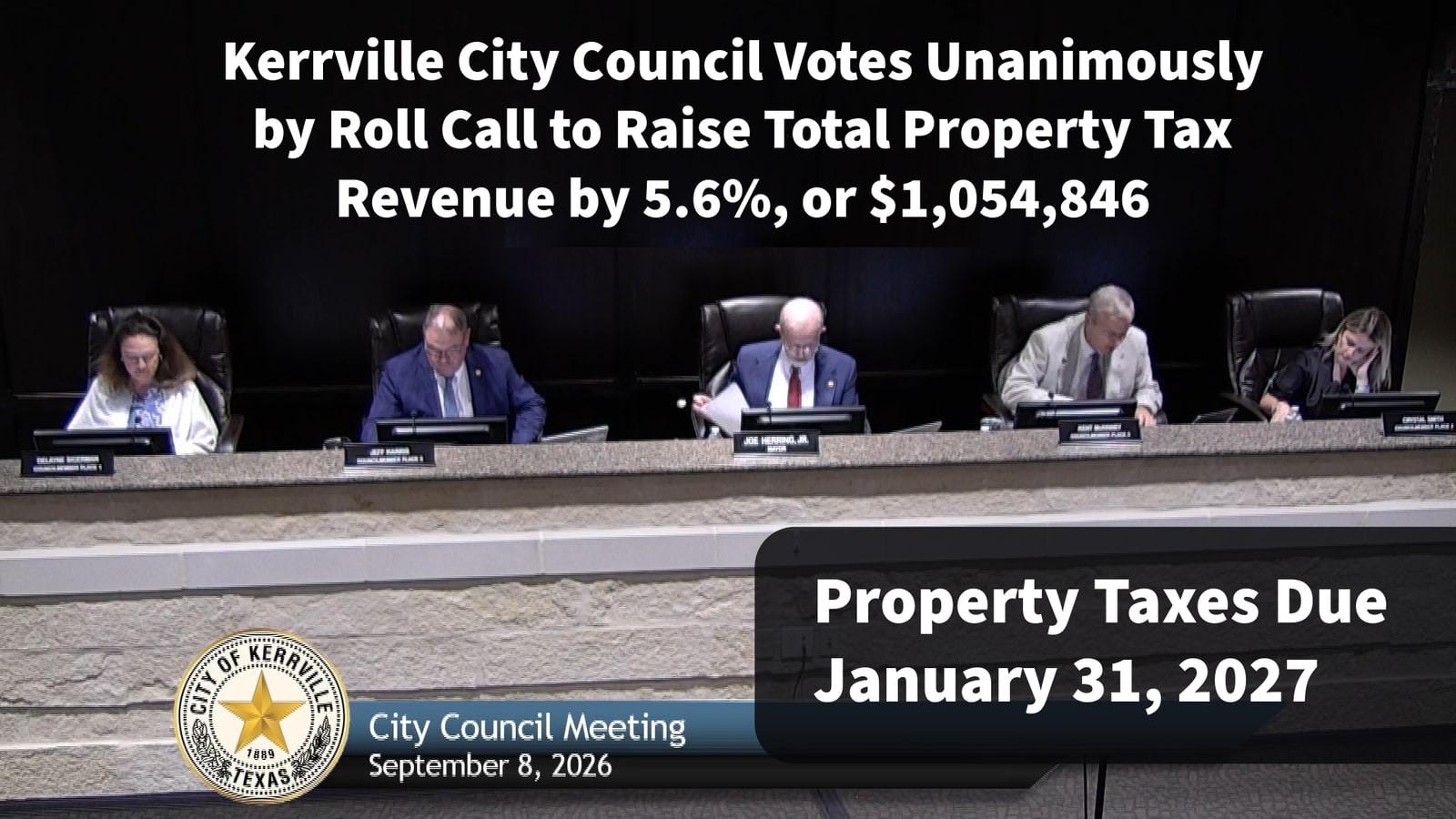
KERRVILLE, Texas — 54 days after the last flash flooding casualty surrounding Kerrville, and for the second September in a row, the Kerrville City Council sat in Council Chambers after a catastrophic flood and adopted a property tax rate the law only permits because of the disaster.
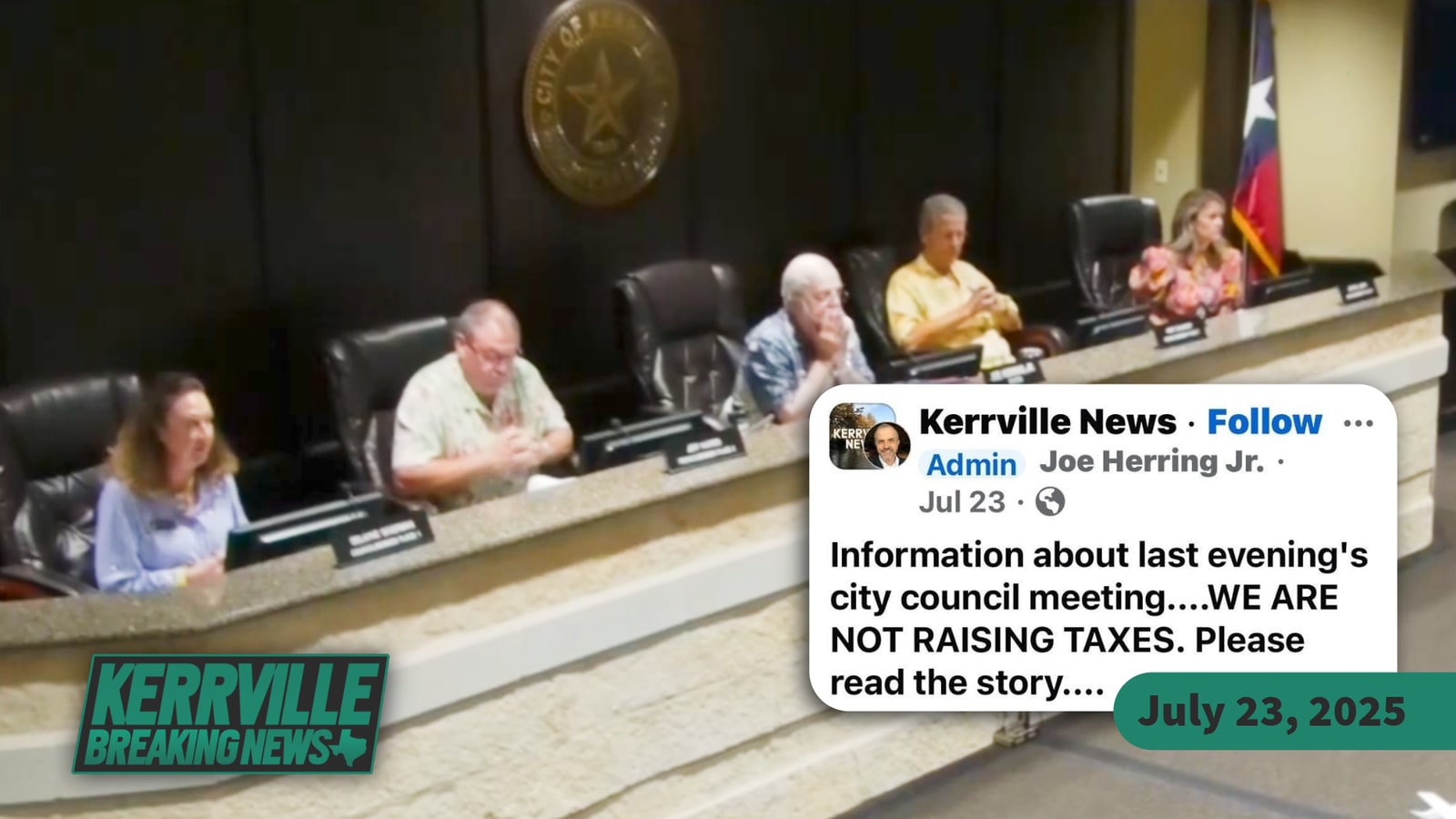
Mayor Herring posted in his Kerrville News Facebook Group July 23, 2025 these exact words: "WE ARE NOT RAISING TAXES." Tonight, while hearing citizen speakers equate the taxation to "extortion," Mayor Herring's response was "I wish I had that much hair."
Tonight's comment wasn't the first off-the-wall statement Mayor Herring has said since the first flooding catastrophe July 4, 2025. Herring told CNN July 6, 2025 that he went outside and looked up at the sky and it didn't look angry the night before July 4, so he just went to bed during a flood watch. In press conferences, he was quoting children TV entertainer Fred Rogers and telling reporters who were asking serious unanswered questions that "This is Kerrville, and we're going to do it my way."
Wednesday will mark one year since Kerrville Breaking News owner Mikaela Jade Taylor became the first person to be kicked out of a Kerrville City Council meeting when she was a victim of and noticed a pattern of sexual misconduct by one of Herring's officers. She attempted to speak for her first time at a City Council meeting after no-one from the City of Kerrville responded to her emails about it. While being asked to leave, Taylor said, "Censor me." Herring said, "I will."
The rest of the article is a continuation of the article from earlier in the day.
And for the second September in a row, the number staff put in front of them is not near the legal ceiling. It is the legal ceiling. Ordinance No. 2026-21 levies $0.5995 per $100 of assessed value. The city's own rate table lists the Voter Approval Disaster Rate for FY2027 at $0.5995. To the penny.
But the rate is not the story. The story is who pays it.
Who the money comes from
State law makes the city print one sentence in its budget hearing notice. Here it is, two years running.
September 9, 2025 — the FY2026 notice:
This budget will raise more revenue from property taxes than last year's budget by an amount of $783,591 which is a 4.6% increase from last year's budget. The property tax revenue to be raised from new property added to the tax roll this year is $417,181.
September 8, 2026 — tonight's notice:
This budget will raise more total property taxes than last year's budget by $1,054,846, which is a 5.6% increase, and of that amount $314,674 is tax revenue to be raised from new property added to the tax roll this year.
New property is the uncontroversial half. A house that did not exist last year pays taxes this year, and nobody's bill went up to make it happen. Subtract it out and you get the number that actually lands on people who already live here.
| FY2026 | FY2027 | |
|---|---|---|
| Total property tax increase | $783,591 | $1,054,846 |
| From new property | $417,181 | $314,674 |
| From property already on the roll | $366,410 | $740,172 |
| Share carried by new construction | 53% | 30% |
Last year, new construction paid the majority of Kerrville's property tax increase. This year it pays less than a third.
The amount taken from property already on the tax roll has doubled — from $366,410 to $740,172. Meanwhile the revenue from new construction fell 25 percent, down $102,507, which is what a building slowdown after two floods looks like in a spreadsheet.
The city is raising more money from a smaller engine, and the difference is being made up by property that was already here on the day of the flood.
And "everybody else" is a smaller group than it sounds
Kerr Central Appraisal District's 2025 Annual CAD Report — the most recent certified totals, published in November — contains a number the city's budget documents never mention.
Of the City of Kerrville's $3,845,382,668 in net taxable value, $1,228,269,585 carries a frozen tax ceiling under the over-65 and disability provisions. That is 31.9 percent of the city's taxable base, across 3,551 accounts, and a rate increase cannot touch any of it.
The scale: the city has 5,637 homestead accounts. 3,551 of them — 63 percent — sit under a ceiling. For nearly two out of every three homesteads in Kerrville, the city tax bill does not move when council raises the rate.
The certified totals show what that leaves. Subtract the freeze and the rate-sensitive base is $2,614,732,777. Of the roughly $19.36 million the city levied in 2025, about $4.43 million — 22.9 percent — was capped and did not respond to the rate at all.
Which means the "median-valued homestead" in every one of the city's taxpayer impact statements is a homestead without a ceiling. It is a real house. It is not the typical Kerrville homestead.
Run the arithmetic and the picture snaps into focus. Apply last year's $0.5711 to the rate-sensitive base and you get $14.93 million. Apply the proposed $0.5995 and you get $15.68 million. The difference is $742,584 — within a few thousand dollars of the $740,172 the city's own notice says will come from property already on the tax roll.
So the increase is not landing on "Kerrville homeowners" as a class. It is landing on the 68 percent of the base that can still be moved: homesteads without a ceiling, rental property, commercial property, and business personal property. Renters get no notice about any of it, and no line on the impact statement.
The $17 nobody will mention
Buried in tonight's agenda is a table the city is required by state law to publish — the Taxpayer Impact Statement, per Texas Local Government Code 551.043(c)(2). Three numbers, and they tell you everything:
| Median-valued homestead | Bill |
|---|---|
| Current fiscal year (2025 tax year) | $1,923 |
| Upcoming year at the no-new-revenue rate | $1,906 |
| Upcoming year at the proposed rate | $2,003 |
Read the middle row again.
At the no-new-revenue rate, the median homeowner's city tax bill would go down $17. Not stay flat. Down. At the proposed rate it goes up $80.
The $97 between those outcomes is not weather, not appraisals, not the flood, not Austin, and not the Kerr Central Appraisal District. It is a vote, taken tonight, by five people whose names are printed on the ordinance.
It is also the second one. Last year's notice ran the identical comparison: the 2025 tax year bill at the proposed rate was $1,923 against $1,796 at no-new-revenue — a premium of $127.
$127, then $97. About $224 a year now sitting permanently in the base.
Two things follow, and honest reporting requires both.
The single-year premium is smaller this time, and the year-over-year increase is much smaller: the median bill rose $211 last year and rises $80 this year. If a councilmember says tonight that this budget asks less of homeowners than last year's did, the documents back them up.
And it compounds anyway. Each year's premium becomes the next year's starting point. Over two budgets the median city tax bill has gone from $1,712 to $2,003 — up $291, or 17.0 percent — while the median home's value rose 9.2 percent. Nobody ever votes on the stack.
Three documents, three values for the same house
Every taxpayer-impact figure Kerrville publishes rests on one input: the value of the median homestead. The city has now put that number in print three times for the same tax year and gotten three different answers.
| Document | 2025 median homestead value |
|---|---|
| FY2026 budget hearing notice (statutory) | $336,669 |
| FY2027 Taxpayer Impact Statement (statutory) | $336,669 |
| Sept. 9, 2025 agenda cover sheet | $333,669 |
| Sept. 8, 2026 slide deck, "Median Home Value Comparison" | $334,669 |
The two statutory notices agree, and they are almost certainly right — $336,669 at $0.5711 produces $1,923, the bill both notices report.
The two documents staff wrote to explain the notices are each wrong, in different directions, a year apart. Last September's cover sheet told council the median homestead was worth $333,669 and would pay $1,906. Tonight's slide deck tells council it was worth $334,669. Three values, each $1,000 apart, a single digit moving in the thousands place across two budget cycles.
Each document is internally consistent with its own figure, which is how the error survives review. Only one of them describes a house in Kerr County.
It matters because the slide is what council looks at. Set against the 2026 median of $334,074, the deck reports a decline of $595, or 0.18 percent, under the headline "A slight decrease in median home value." Using the statutory figure the decline is $2,595 — 0.77 percent, more than four times as large.
For completeness: tonight's tax ordinance cover sheet puts the 2026 median at $334,070. The slide says $334,074.
Kerr CAD's published certified totals report net taxable value by entity, not a median homestead figure, so the number originates in the exchange between the district and the city.
The rate table
| Rate | FY2026 | FY2027 |
|---|---|---|
| No New Revenue | $0.5335 | $0.5706 |
| No New Revenue M&O | $0.3987 | $0.4314 |
| Voter Approval M&O | $0.4126 | $0.4454 |
| Interest & Sinking (debt) | $0.1406 | $0.1392 |
| Total Voter Approval | $0.5579 | $0.5846 |
| Voter Approval Disaster Rate | $0.5711 | $0.5995 |
The ordinary voter-approval rate — the one the city could adopt in a normal year without asking anybody — is $0.5846. Council is being asked for the disaster number instead.
Behrens' revenue estimate for that gap: $14,417,000 in General Fund revenue at the voter approval rate, $14,906,600 at the disaster rate. Difference: $490,000.
Last September, City Manager Dalton Rice told council the same mechanism would produce about $336,817. Two years of disaster-rate premiums now total roughly $826,000 — and the meter has just been set back to zero.
For scale: at the July 28 council meeting, city staff reported roughly 820 flood-damage reports inside Kerrville and more than $55 million in preliminary flood-related damage. The disaster designation that damage unlocks is worth $490,000 at the tax office this year.
Note where the increase lives. Last year the debt portion of the rate was unchanged at $0.1406 and the entire increase was M&O, $0.4189 to $0.4305. This year debt goes down to $0.1392 while M&O goes up nearly three cents, to $0.4603. Debt service is money prior councils already committed. Maintenance and operations is what this council chooses to spend. Both years, the whole increase sits in the discretionary half.
The clock everyone assumed was running out
State law does not hand a city the disaster rate forever. It can be used for up to three years, or until total taxable value exceeds the total value of the disaster year, whichever comes first.
Last September that framing did a lot of work. The rate was temporary. It had an expiration date. Residents were told it would lapse after FY2028.
That is no longer the arithmetic. FY2027 is not year two of the July 2025 clock. It is year one of a fresh 2026 disaster declaration.
The paper trail is public, and it runs through Austin. Kerr Central Appraisal District's own disaster-exemption notice states it plainly: Governor Abbott declared Kerr County a disaster area on July 17, 2026. That gubernatorial declaration is the trigger the Tax Code keys on — the 8 percent calculation is available to a taxing unit located in an area declared a disaster area by the governor or the president during the current tax year.
Locally, Mayor Joe Herring Jr. signed a City of Kerrville disaster declaration in the early morning hours of July 16, 2026, as the Guadalupe went over its banks for the second time in thirteen months. Texas law caps a mayor's initial declaration at seven days, so council called an emergency meeting for 3 p.m. Wednesday, July 22, and voted unanimously to extend it. Resolution No. 31-2026 extends the declaration indefinitely — until Herring, or a future mayor, decides it is no longer needed. City Attorney William Tatsch told council the resolution also continues the city's emergency management plan and broadens the city manager's authority to seek aid.
And here is the part nobody has connected to tonight's rate. At that same July 22 meeting, Herring said the July 2025 flood declaration remains separately in effect and has not been rescinded.
Two live disaster declarations. Neither retired. The city has not been asked, on the record, which one the FY2027 disaster rate is calculated against — or what happens to the three-year limit when a second declaration lands on top of a first one that never ended.
The window restarts: FY2027, FY2028, FY2029, measured from the new disaster. Stack that on the year already taken under the 2025 declaration and Kerrville is looking at up to four consecutive fiscal years of rates set above the ordinary voter-approval ceiling, without a single election.
The reset moves the other benchmark too. The rate also expires when taxable value climbs back above the disaster year's total — a test that now measures against the 2026 roll, already diminished by the second flood, instead of the healthier 2025 roll. A lower bar is easier to clear, which shortens the runway. A lower starting point is also what the growth calculation applies to, which is how a rate can be labeled the disaster maximum while the effective M&O increase comes in at 6.70 percent, below last year's 7.98.
Both things are true at once. Council should be asked which it is relying on. Nobody on the dais volunteered the reset.
What the ordinance is required to say out loud
Section Five of Ordinance 2026-21, in capital letters because state law says it has to be:
THIS TAX RATE WILL RAISE MORE TAXES FOR MAINTENANCE AND OPERATIONS THAN LAST YEAR'S TAX RATE. THE TAX RATE WILL EFFECTIVELY BE RAISED BY 6.70% AND WILL RAISE TAXES FOR MAINTENANCE AND OPERATIONS ON A $100,000 HOME BY APPROXIMATELY $28.90.
Councilmembers are scripted to move it aloud: "that the property tax rate be increased by the adoption of a tax rate of $0.5995, which is effectively a 6.70% percent increase in the tax rate."
The budget ordinance is quieter. Ordinance No. 2026-20 requires councilmembers to take a second, separate vote — at both readings — on this motion:
Motion ratifying vote to adopt a budget that will require raising more revenue from property taxes than the previous fiscal year.
That is the whole sentence. No amount. No percentage. The $1,054,846 lives one document over, in a notice.
The wording is identical to last year's Ordinance No. 2025-18, which carried the same bare motion while $783,591 sat in the FY2026 hearing notice. Two budget cycles, two ratification votes whose entire purpose is to force the increase into the open, and neither ordinance names a figure.
A councilmember can vote yes on "raising more revenue from property taxes than the previous fiscal year" without ever saying, on the record, how much.
What it costs, by house
The city's property owner impact table — no exemptions, city taxes only:
| Taxable value | FY2026 rate | FY2027 voter approval | FY2027 disaster rate | Change vs. FY2026 |
|---|---|---|---|---|
| $100,000 | $571 | $585 | $600 | +$29 |
| $200,000 | $1,142 | $1,169 | $1,200 | +$58 |
| $300,000 | $1,713 | $1,754 | $1,800 | +$87 |
| $500,000 | $2,856 | $2,923 | $3,000 | +$144 |
| $1,000,000 | $5,711 | $5,846 | $6,000 | +$288 |
On a $100,000 home the ordinary voter-approval rate would cost $14 more than last year. The disaster rate costs $29. The disaster piece roughly doubles it.
The budget itself
Ordinance No. 2026-20 adopts the FY2027 budget. Against last year's published summary:
| Fund | FY2026 | FY2027 |
|---|---|---|
| General Fund (balanced) | $39,145,111 | $41,921,458 |
| Water Fund (balanced) | $17,589,715 | $18,369,442 |
| Capital Projects revenues | $14,679,665 | $26,913,081 |
| Capital Projects expenditures | $27,806,035 | $34,068,741 |
| Total revenues | $102,244,298 | $123,077,230 |
| Total expenditures | $117,168,972 | $127,703,250 |
| Revenues under expenditures | ($14,924,674) | ($4,626,020) |
| Transfers between funds | $22,846,583 | $21,534,763 |
Total revenues are up 20.4 percent in one year. Expenditures are up 9.0 percent. The gap between them narrowed by more than $10 million.
The single largest mover is Capital Projects revenue, up 83 percent — $14.7 million to $26.9 million. In a city that has absorbed two federally significant floods in thirteen months, the obvious question is how much of that is disaster reimbursement, how much is bond proceeds, and how much is recurring. Ask, because a one-time reimbursement bulge inside a total revenue figure makes a budget look healthier than the operating funds are.
Both years' totals include transfers between funds — $21.5 million tonight, roughly 17.5 percent of the headline revenue figure moving from one city pocket to another and being counted on the way past.
Everything else on tonight's agenda
5 p.m. workshop — one item.
2.A Stormwater Utility Fee update and review. (D. Barrera, Director of Public Works.) Filed under "Information and Discussion," described as items "not expected to require action." The same paragraph then says items in that section "may become action items on request of any Councilmember, and City Council may take action on any item listed in this section without further notice."
A utility fee is not a property tax. It is not subject to the no-new-revenue rate, the voter-approval rate, or the disaster rate. It does not appear in the capital-letter warning in Section Five. It arrives on a different bill. Sixty minutes before council votes to max out the disaster tax rate, it will be reviewing a fee on the same properties for the same water.
6 p.m. regular meeting. Councilmember Crystal Smith gives the invocation. Proclamations for United States Constitution Week and National Recovery Month. Then:
5.A — Ordinance 2026-20, adopting the FY2027 budget. Public hearing, first reading. (Behrens)
5.B — Ordinance 2026-21, the tax levy. Public hearing, first reading. (Behrens)
5.C — Ordinance 2026-22, rezoning a portion of 2001 Sidney Baker Street from General Commercial (C-3) to Medium Density Residential (R-2). Public hearing, first reading. (D. Paxton, Director of Development.) A commercial corridor parcel converting to housing, on a night when nobody will be looking at anything but the tax rate.
6.A — Ordinance 2026-23, amending the Animals Code (Chapter 18): new definitions, enhanced management of feral cats, an increased insurance requirement for dangerous dogs, and liability provisions for property damage caused by removing an animal from a vehicle or enclosed trailer. First reading. (Paxton)
7.A — Resolution 42-2026, a Conditional Use Permit for general contractor, maintenance and repair operations at 403 Schreiner Street, in a Light Commercial (C-2) district, subject to conditions. Public hearing. (Paxton)
8.A — Appointment of Municipal Court Judge. (K. Meismer, Assistant City Manager / W. Tatsch, City Attorney.) Flagged as eligible for executive session under Government Code 551.074, and listed again at item 10.A as an executive session item. The city's judge is very likely to be selected behind a closed door, with the vote taken in public afterward.
9.A — Appointment to the Tax Increment Reinvestment Zone Board #1. (S. McElhannon, City Secretary.) TIRZ No. 1 is the same zone where council recently approved an additional $50,000 for the Exterior Enhancement Grant Program and $50,000 for the Parking Lot Grant Program. Who sits on that board decides where that money lands — and the timing is worth noting: TIRZ #1 meets at 3 p.m. tomorrow, Wednesday, September 9, at City Hall. Tonight's appointee takes a seat with roughly eighteen hours to spare.
10 / 11 — Executive session on the judge appointment, then any resulting action. 12 — Items for future agendas.
Consent is minutes only: the August 25 workshop and the August 25 regular meeting.
Who votes, and when
Tonight is first reading only. Second and final reading is September 22, 2026.
The record vote sheet in Ordinance 2026-21 lists:
- Joe Herring, Jr., Mayor
- Delayne Sigerman, Place 1
- Jeff Harris, Place 2
- Kent McKinney, Place 3
- Crystal Smith, Place 4
One seat has changed since the FY2026 budget passed. Ordinance 2025-18 lists Brenda Hughes in Place 4; Crystal Smith holds it now. Smith cast the only no on the $1.84 million Granger MacDonald Park parking lot contract in July, arguing the money belonged at existing parks destroyed by the floods. Harris was the lone no on last year's tax rate. Tonight, Smith gives the invocation.
The city attorney has changed too — Michael C. Hayes signed the FY2026 budget ordinance, William L. Tatsch signs this one.
And from the tax ordinance cover sheet, without comment:
Kerrville 2050 Item? No.
The budget calendar, for the record
Tonight's tax ordinance cover sheet lists Date Submitted: 07/20/2026, close enough to the second flood to look like something. It isn't. Ordinance No. 2026-20 recites the rule in its own opening paragraph: under City Charter Sections 8.01 and 8.03 and Section 102.005 of the Texas Local Government Code, the City Manager prepared and filed the proposed FY2027 budget on or before July 31, 2026. Last year's ordinance recites the same deadline. The July filing is the law, not a reaction.
What the calendar does show is how tight the window is. The proposed budget was locked in roughly two weeks after the second flood — drafted before anyone could know the damage or the tax roll. Council's real leverage is the amendment process between filing and adoption, not the filing itself.
Ask what changed between July 31 and tonight — because something did. The city's budget page carries two versions of the FY2027 proposed budget: the statutory PDF labeled "As of 07/31/2026," and a digital edition labeled "Updated 08/27/2026." Four weeks separate them. Nothing on the page says what moved.
A disclosure page that stops in 2024
Tax Code Section 26.16, as amended by Senate Bill 2 in the 86th Legislature, requires cities to post their tax rate calculation and related disclosures. The City of Kerrville maintains a Truth in Taxation page for exactly this purpose, under the Finance Department.
As of tonight, the most recent year posted there is Tax Year 2024.
There is no 2025 entry. There is no 2026 entry. Which means the Form 50-856 tax rate calculation worksheets — the documents that show line by line how the disaster voter-approval rate of $0.5711 was derived last year, and how $0.5995 was derived this year — are not on the page the city built to hold them.
Those worksheets would answer, on paper, the question nobody has put to staff out loud: which disaster declaration the FY2027 rate is calculated against, and what the three-year clock does when a second declaration lands on a first that never ended.
How to watch tonight
Workshop: 5:00 p.m., City Hall, 701 Main Street.
Regular meeting, budget hearing and tax hearing: 6:00 p.m., same address,
Council Chambers.
On TV: Spectrum Channel 2.
Online, live: Live-stream via the city's website, https://kerrvilletx.gov. Both meetings are recorded and posted afterward. Recordings also appear on the City of Kerrville – Government channel on YouTube.
To speak on an agenda item: Submit a completed "speaker request form" to the City Secretary before the item is introduced — the city encourages submitting it before the meeting begins. For the workshop, submit before the workshop starts. Four minutes per speaker.
To speak on something not on the agenda: Visitors/Citizens Forum, item 3. Same form, same four minutes. Council may not discuss or act on what you raise, but it can place the issue on a future agenda.
The chamber is wheelchair accessible with accessible parking. Accommodation or interpretive services require 48 hours' notice: City Secretary's Office, 830-258-1118.
To read it yourself: The FY2027 proposed budget is on the city website homepage, at the City Secretary's Office in City Hall during business hours, and at the Butt-Holdsworth Memorial Library, 505 Water Street, during library hours.
Both agendas were posted September 1 at 3:30 p.m. by City Secretary Shelley McElhannon. You have had a week. Tonight you have four minutes.
Kerrville Breaking News will report the vote.