Kerrville Spent a Week Saying It Doesn't Use Flock. Audit Logs Show a "Kerrville TX PD" Account Searched Flock's National Network.
City of Kerrville
KERRVILLE, Texas — For four days last week, the City of Kerrville and its police department worked to assure residents of one thing: Kerrville doesn't use Flock, the license plate surveillance company at the center of a national privacy backlash. KPD said it "does not utilize Flock cameras." The city's follow-up press release put it in bold: the city and KPD "do not own or operate Flock-brand ALPR cameras."
Publicly released Flock audit logs tell a more complicated story.
The audit logs
Flock Safety's network audit logs — obtained through public records requests filed with Flock customer agencies across the country and compiled by the transparency project HaveIBeenFlocked.com — record at least nine searches of Flock's camera network conducted under an agency account labeled "Kerrville TX PD" between September 15, 2023 and January 5, 2025.
The logged searches include:
- A September 15, 2023 lookup, reason "Associated with a Wanted Subject," run with a Texas filter across 3,445 camera networks and 59,147 devices nationwide.
- A September 16, 2023 lookup citing a theft case number in KPD's numbering format, run across 3,446 networks and 59,149 devices.
- "Locate" lookups in December 2023 and January 2024 across roughly 400 networks each.
- Three April 13, 2024 lookups, reason "locate narcotics suspect," each run across 4,411 networks.
- A January 5, 2025 search, reason "STOLEN," across 13 networks.
The searches are visible because Flock's nationwide lookups leave an entry in the audit log of every participating network they touch. The Kerrville account's queries appear in audit files released under public records laws by Flock customers in at least ten states — including Salem, Massachusetts; Cheshire, Connecticut; Louisville, Kentucky; El Cajon, California; Cobb County, Georgia; and, in Texas, Bryan PD, Huffman ISD PD and Harris County. Each source file is published with a cryptographic hash and a link to the originating records request.
Two caveats matter. First, the logs identify an agency account, not the officers who used it, and Kerrville Breaking News has not independently confirmed who created or operated the account. Second, by HaveIBeenFlocked's own methodology, only nationwide lookups are generally visible in other agencies' audit files — statewide or local Flock searches would not appear. Nine is a floor, not a total.
But the account's existence is difficult to reconcile with the week's messaging — and it may explain the messaging's evolution. Flock provides search access to law enforcement agencies that own no Flock cameras at all. An agency can "not own or operate Flock-brand ALPR cameras," as the city's August 14 release carefully phrased it, while holding login credentials to search everyone else's. KPD's August 11 statement — that the department "does not utilize Flock cameras" — is the claim the audit logs put in question. The city's release three days later quietly narrowed the denial from use to ownership. The logs suggest why that word choice matters.
The April 2024 searches deserve their own footnote. KPD's August 11 release credits ALPR technology with locating "dozens of felony narcotics suspects." The Flock audit logs show the Kerrville TX PD account running "locate narcotics suspect" queries across 4,411 camera networks that same year. If those narcotics results came in part through Flock's network, then Flock is not adjacent to KPD's ALPR success stories — it is one of them.
How we got here
What the city has confirmed came out over four days of escalating statements. In a three-page press release issued Friday, August 14, the city and KPD confirmed the department operates eight fixed automated license plate reader (ALPR) cameras at three access points into the city, plus two mobile units — one on a KPD patrol vehicle and one on a City Marshal vehicle. The timeline:
August 10: The New York Times publishes a story on Flock surveillance systems. Mayor Joe Herring Jr. would later write that he read it that morning and "had no idea what a Flock system was."
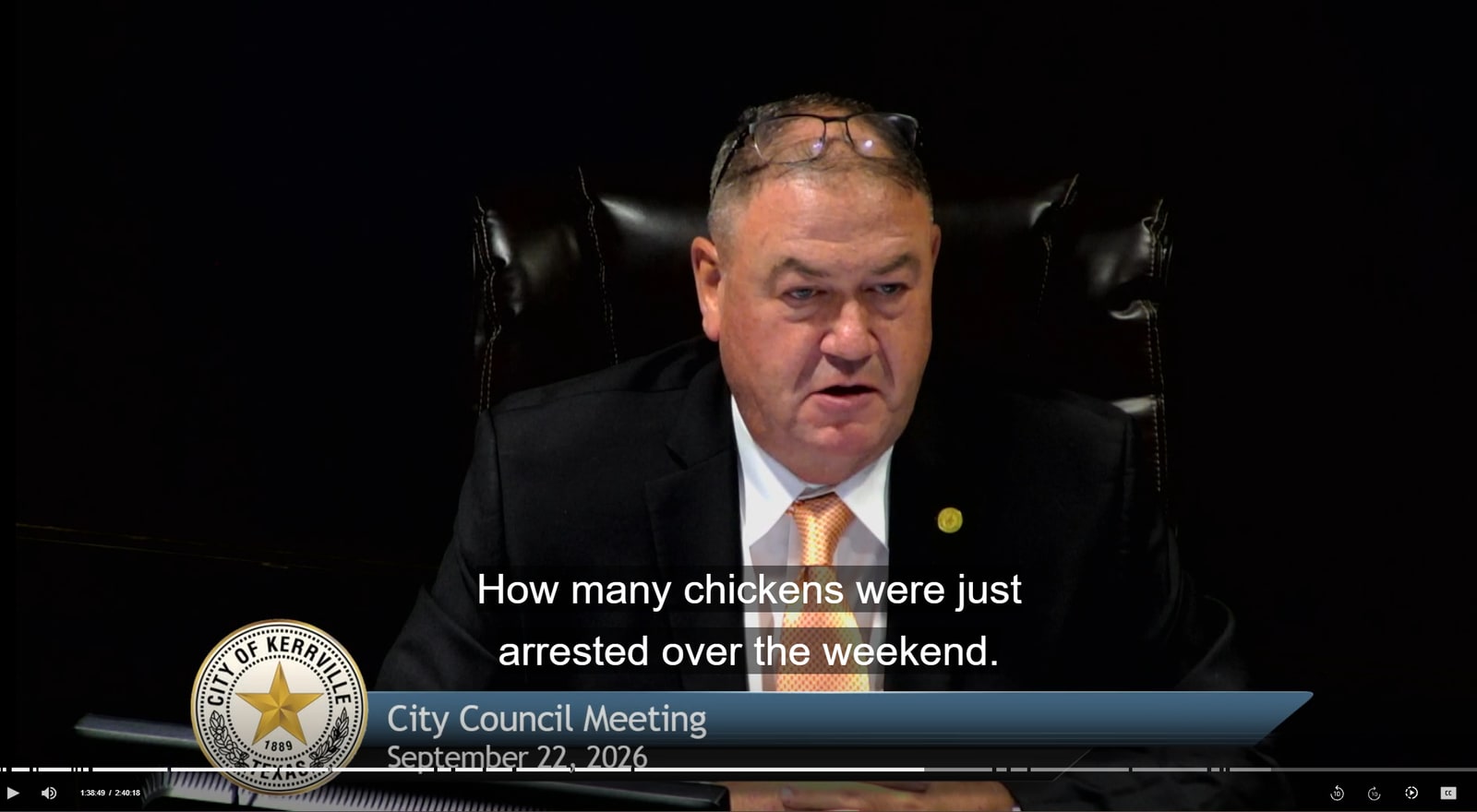
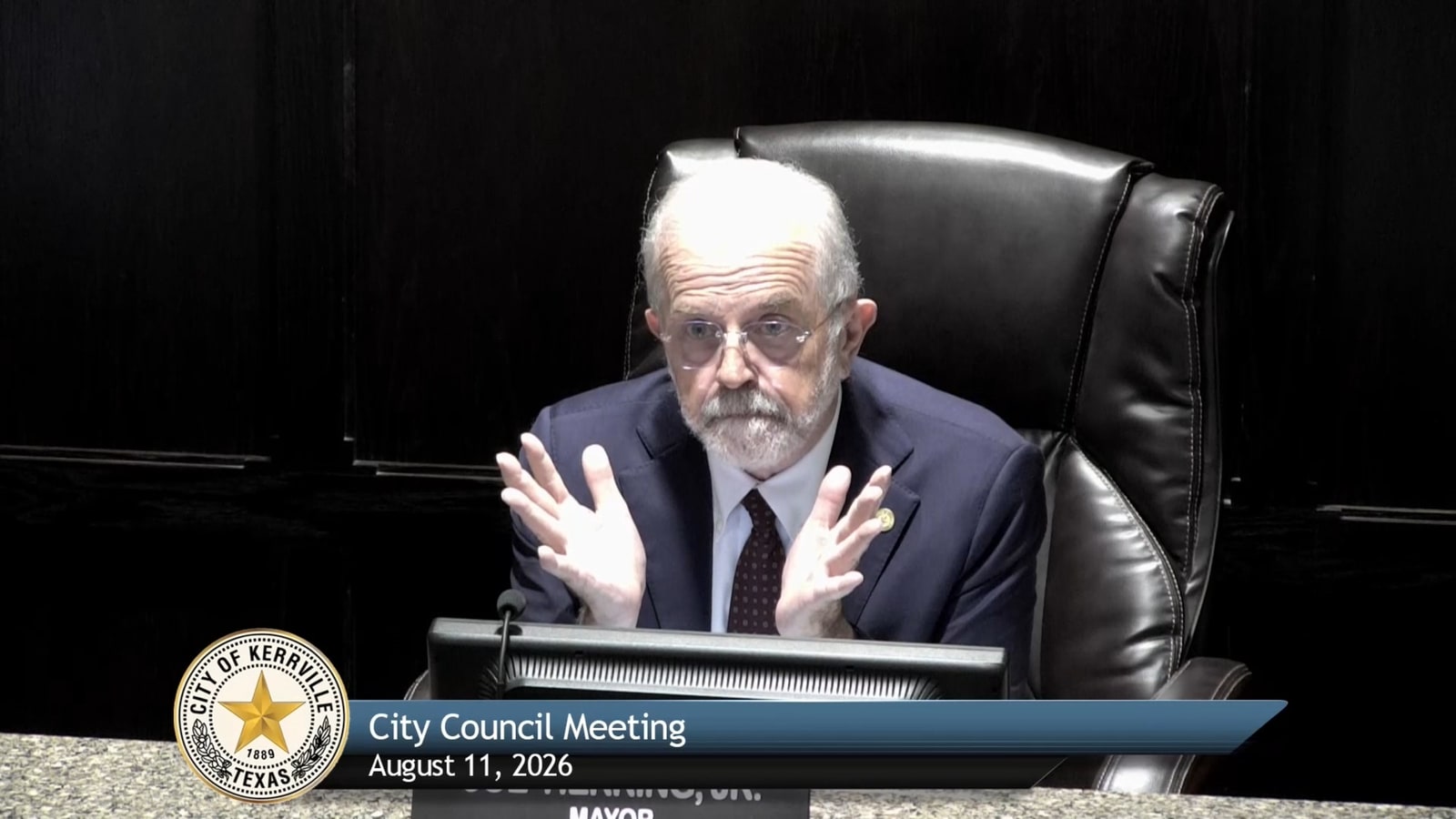
August 11: At that evening's city council meeting, Herring tells the public the city government does not have Flock cameras — after some of Kerrville's stationary units appeared on a crowdsourced "DeFlock" surveillance map, mislabeled as Flock devices. The same day, KPD issues its own news release through Sgt. Jonathan Lamb confirming the department has used ALPR technology for "about 15 years" and currently operates two Motorola mobile units and eight stationary Leonardo cameras at entryways to the city.
On or about August 13: Herring posts a lengthy apology on his personal Facebook page acknowledging his council statement "can easily be seen as intentionally misleading." The city does operate license plate readers, he wrote — and his denial was, in his own analogy, like saying "we don't have Fords" when the city actually has Chevrolets.
August 14: The city issues a second, three-page release — the first official document to disclose where the data is actually stored.
Herring's apology post also disclosed the money trail and his own role in it. The cameras were funded through the Office of the Governor's Edward Byrne Memorial Justice Assistance Grant Program — federal criminal justice money — in an amount not to exceed $70,522. The Kerrville City Council passed the resolution authorizing KPD to accept the grant in November 2023, and Herring voted in favor of it: roughly two years and nine months before he told council he didn't know what the technology was.
The two official releases don't quite agree with each other, either. KPD's August 11 statement says the department has used ALPRs for "about 15 years." The city's August 14 release says since 2012 — fourteen years. Small discrepancies, but in a week devoted to correcting the record, the record should at least match itself.
What the release confirms
According to the city, KPD has used ALPR technology since 2012, with the fixed cameras in place since late 2023. The fixed units are manufactured by Leonardo US Cyber and Security Solutions. The mobile units are made by Vigilant LPR, a Motorola Solutions company.
The release describes the standard safeguards: no facial recognition, no continuous GPS-style tracking, no traffic citations, no capturing signals from electronic devices. Alerts are "investigative leads only" and do not by themselves constitute probable cause. Access is limited to authorized law enforcement users, and searches are logged and subject to review.
Where the data actually lives
Buried on page three is the detail residents should read twice. Per the city's own release:
- Data from the Leonardo fixed-camera system "is maintained through the local High Intensity Drug Trafficking Areas, or HIDTA, network."
- Data from the Vigilant mobile units "is maintained on Vigilant servers."
Neither of those is a filing cabinet at 429 Sidney Baker Street.
HIDTA is a federally funded drug task force program administered through the Office of National Drug Control Policy. Storing Kerrville plate scans on a HIDTA network means the data sits inside a regional law enforcement information-sharing system — not solely under KPD's roof.
Vigilant is the other half of the story. Vigilant Solutions has long operated one of the largest commercial license plate databases in the country, and its parent company Motorola also owns Digital Recognition Network, which aggregates billions of privately collected plate scans. "Maintained on Vigilant servers" means Kerrville's mobile ALPR data is stored in a vendor's cloud infrastructure — the same architecture that makes Flock controversial in the first place.
The release says requests from other law enforcement agencies for ALPR data are "subject to authorization and applicable department procedures." It does not say which agencies have requested access, how often, whether any requests have been denied, or whether federal agencies can query the HIDTA-hosted data directly without asking KPD at all.
The success story that proves the point
KPD's August 11 release leads with its best case for the technology: in February 2026, a 38-year-old Kerrville woman was abducted downtown, a statewide CLEAR Alert was issued, and she was safely recovered 200 miles away in Somerville, Texas, with the suspect charged with aggravated kidnapping. According to KPD, the department, the Texas Department of Public Safety, and the Burleson County Sheriff's Department "all utilized ALPR technology" in the recovery.
That outcome is unambiguously good. It is also, read carefully, a description of exactly the system the "we don't use Flock" framing invites residents to believe Kerrville sits outside of.
A vehicle tracked from Kerrville to Burleson County was not found by eight cameras at Kerrville's entryways. It was found because plate data flows between agencies across the state — and DPS, one of the three agencies KPD credits, operates Flock cameras and runs searches that reach across networks of thousands of cameras statewide. Kerrville's cameras may not say Flock on the housing. The system they feed into, and benefit from, is the same interconnected surveillance network — which is precisely why the unanswered questions about retention, sharing, and outside access matter more than the brand name.
The KPD release also touts that ALPR technology has helped locate "dozens of felony narcotics suspects" — a figure worth holding next to the city's later disclosure that the fixed-camera data is maintained on the regional High Intensity Drug Trafficking Areas network. The narcotics results and the drug task force data-hosting arrangement are not a coincidence; they are the same pipeline.
And one claim deserves particular scrutiny: KPD states it has had "zero instances" of anyone being subjected to a law enforcement contact because of an inaccurate ALPR alert. That may be true. But it is an audit conclusion offered without an audit — no search counts, no review results, no methodology. It is also narrowly worded: zero contacts from inaccurate alerts says nothing about how many times the system was queried, by whom, or for what.
What the release doesn't say
The statement omits the basic accountability numbers that ALPR policies in other Texas cities routinely disclose:
- Retention period. How long are plate scans kept before deletion? The release doesn't say — not for the Leonardo data on the HIDTA network, and not for the Vigilant data.
- Search volume. How many ALPR searches have KPD users run? The release says searches are "logged and subject to review" but discloses no audit results.
- Hit rate. Of the plates scanned, how many were connected to any crime?
- Outside access. Whether agencies outside Kerr County — including federal agencies — have queried the data, and under what authority.
These are not hypothetical concerns. Statewide reporting this month found that some Texas law enforcement ALPR searches scan through networks of more than 7,000 cameras, and departments that opt into national lookup programs can be queried by agencies anywhere in the country. Across the U.S., officers have repeatedly been caught using ALPR systems to track ex-partners and romantic interests — including a sheriff who searched for his wife's vehicle hundreds of times and a deputy who ran a woman's plate 1,639 times.
Kerrville's release says the right words about safeguards. What it doesn't provide is a single number demonstrating those safeguards are working.
How the city chose to tell you
There is also the matter of how this "transparency" statement reached the public. The press release was distributed in part through Mayor Joe Herring Jr.'s personal Facebook profile, where he wrote that "transparency is important on this issue."
A personal Facebook page is not a public record channel. Residents the mayor has blocked cannot see official city communications posted there — and under the U.S. Supreme Court's 2024 decision in Lindke v. Freed, a public official who uses a personal account to speak on behalf of the government may not constitutionally exclude constituents from that speech. A city that wants credit for transparency should distribute its statements through channels every resident can access, not through an account with a block list.
The bottom line
Kerrville doesn't own Flock cameras. But publicly released audit logs show a Kerrville TX PD account searching Flock's national camera network — tens of thousands of devices at a time — across at least sixteen months, including for the narcotics cases the department now cites as ALPR success stories. Meanwhile the city's own cameras, bought with federal grant money the council approved in 2023, feed data to a federal drug task force network and a Motorola-owned cloud, with no disclosed retention periods, audit results, or accounting of who else can see it.
The mayor's Ford-versus-Chevrolet analogy was more honest than the press release that followed it — except the audit logs suggest the city may have been borrowing the neighbor's Ford all along.
Herring, for his part, wrote that he will "try to find out the details of our local program." Residents shouldn't have to depend on the mayor's homework. The council voted for these cameras. The details were available then — and the Flock search records are available now.
Kerrville Breaking News has submitted questions to the City of Kerrville and KPD, including: whether KPD holds or has held a Flock Safety search account; who authorized it and under what agreement; whether the department's narcotics-related ALPR results involved Flock network queries; the case file for theft report 2301769 referenced in the audit logs; data retention periods for the Leonardo and Vigilant systems; and audit logs of all ALPR searches. This story will be updated.
Sources: Flock Safety network audit logs compiled by HaveIBeenFlocked.com (agency ID 8959, "Kerrville TX PD"), sourced from public records releases by agencies including Salem MA PD, Cheshire CT PD, Louisville Metro KY PD, El Cajon CA PD, Bryan TX PD, Harris County TX and Cobb County GA PD; Kerrville Police Department news release, Aug. 11, 2026; City of Kerrville press release, Aug. 14, 2026; Mayor Joe Herring Jr. public Facebook statement, August 2026; Kerrville City Council resolution, November 2023; Texas Tribune/Waco Bridge, Aug. 3, 2026; Institute for Justice ALPR misuse tracker, 2026.